
The New Professor Comet Report is ready!

The Comets of the Mid Autumn 2012!

Look towards the night sky!

Vere upward towards the constellations of Pegasus (The Winged Horse of Perseus) and Andromeda (daughter of Cassiopeia and Cepheus 'both Queen & King respectfully of Aethiopia in Ancient Times)!
General Meeting Topic
Lunar Science: Unraveling the Secrets of the Solar System
General Meeting Speaker
Dr. Jennifer Rapp, Lunar and Planetary Institute
Novice Meeting Topic
A Brief Tour of the Winter Constellations
Novice Meeting Speaker
Justin McCollum

The Moon is Earth’s closest neighbor, and the only other planetary body so far that humans have walked on. It has also seen very little geological activity in the last 3 billion years, making it an excellent laboratory to study the very earliest processes in the solar system. We are able to use samples returned from the Moon by the Apollo program, lunar meteorites and orbital data to build an understanding of planetary formation processes and solar system dynamics, and even to learn more about the Earth.

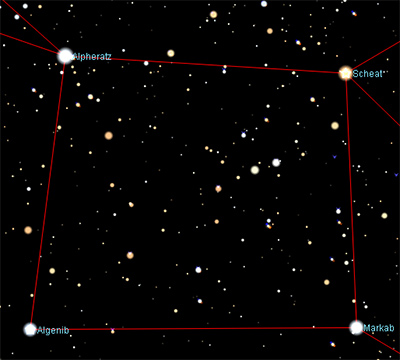
Shallow Sky Object of the Month: Great Square of Pegasus

The Great Square of Pegasus, North to the top. Star chart generated by TheSkyX © Software Bisque, Inc. All rights reserved. www.bisque.com
Object: Great Square of Pegasus
Class: Asterism
Constellation: Pegasus
Magnitude: Scheat (NW corner) : 2.4
Markab (SW corner): 2.5
Algenib (SE corner): 2.8
Alpheratz (NE corner): 2.1
R.A.: 23 h 38 m (appx center of square)
Dec: 22 deg 14 min (appx center of square)

Why this is interesting:

This is a large area of the sky, taking up approximately 184 square degrees (my estimate) and many astronomers say that there’s not much of interest within that square.

The knock on the Great Square of Pegasus is that it is devoid of stars. It’s not